
Butterfly Valley (Kelebekler Vadisi): The Hidden Paradise Below Faralya — Lycian Way Day 3
The Butterfly Valley (Kelebekler Vadisi) to Faralya lycian way hike covers approximately 2.5 km one-way, descending 270 metres via a steep limestone cliff path with fixed chains. The route forms part of Lycian Way Day 3. The descent takes 45–60 minutes; the return climb 60–90 minutes. The valley floor offers a pebble beach, freshwater spring, and camping area.
Butterfly Valley (Kelebekler Vadisi): The Hidden Paradise Below Faralya — Lycian Way Day 3
The descent from Faralya into Butterfly Valley is one of the most technically demanding short sections on the entire Lycian Way — and one of the most misrepresented. Over 18 years of guiding international groups along this trail, we have seen more injuries on this 2.5 km drop than on any comparable distance elsewhere on the route. This guide covers the exact terrain, the chain section, the valley floor, logistics from Faralya, the boat trip alternative, and the conditions under which we advise clients not to attempt the descent at all.
Quick Reference: Butterfly Valley — Faralya Descent
What Is Butterfly Valley and Why Does It Sit on Day 3?
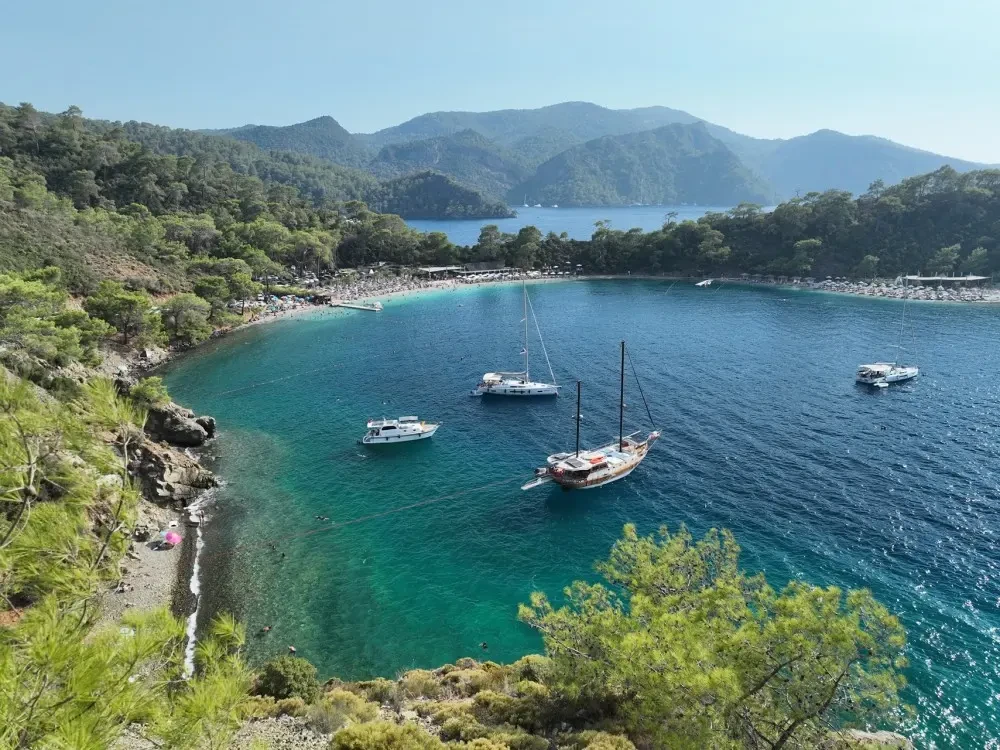
Butterfly Valley — Kelebekler Vadisi in Turkish — is a narrow gorge cut into the limestone massif of Babadağ, directly below the cliff-perched village of Faralya, approximately 12 km southwest of Ölüdeniz on Turkey's Turquoise Coast. The valley takes its name from the Jersey Tiger moth (Euplagia quadripunctaria), which congregates in the gorge in significant numbers between June and September. The species is drawn by the dense stands of jersey tea (Ceanothus americanus) and the microclimate created by the steep canyon walls, which maintain lower temperatures and higher humidity than the surrounding terrain.
On the Lycian Way as designated by Kate Clow — whose original route documentation we have worked with directly since the trail's formal inception — Butterfly Valley appears on Day 3 of the classic Ölüdeniz-to-Kalkan traverse. The standard day runs from Kabak to Faralya (or the reverse), with the valley access point sitting midway in elevation terms between the two villages. Most through-hikers visit the valley as a side descent from Faralya rather than a through-route, as the valley floor has no direct onward path to Kabak that avoids returning to the cliff rim.
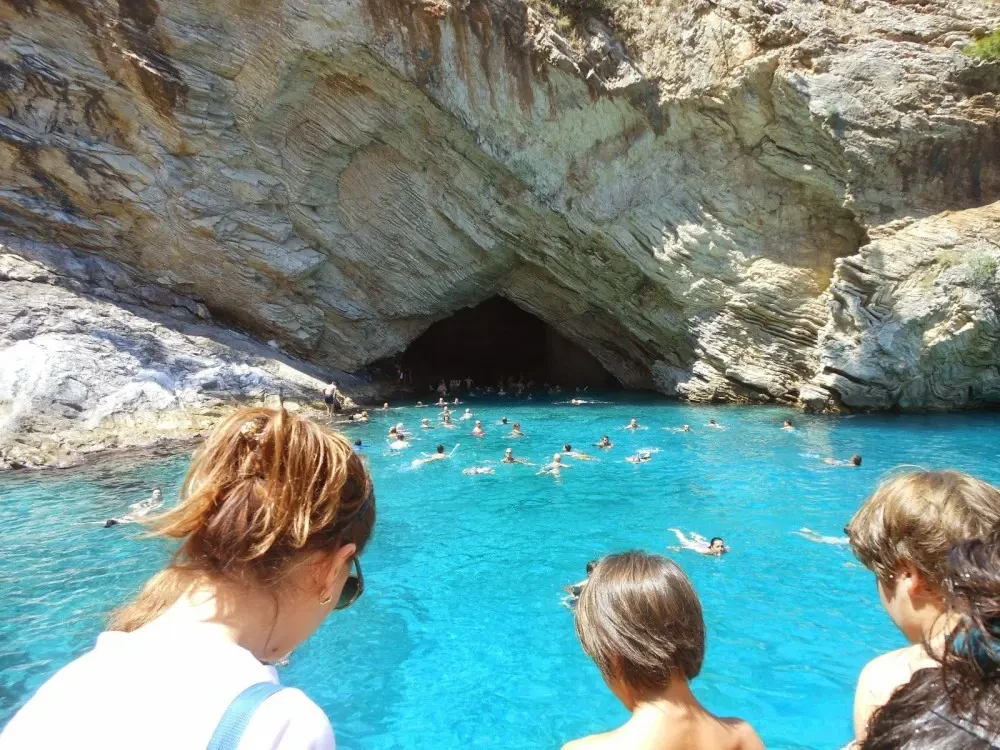
The valley opened to international tourism in the 1990s. For a period it operated as a semi-permanent camp site, attracting backpackers and festival-goers. The current arrangement — seasonal camping with basic facilities, boat access from Ölüdeniz, and the cliff path from Faralya — dates from the 2000s. The beach is pebble, approximately 150 metres long, with clear water and no permanent structures beyond a seasonal café and toilet block.
The Faralya Trailhead: Where the Descent Begins
The descent path begins at the western edge of Faralya village, marked from the road above the George Hotel. The George is the primary accommodation option in Faralya and also serves as a reliable checkpoint for asking locals about current trail conditions — the fixed chain section is subject to seasonal maintenance and is not always in the same configuration year to year. The trailhead sits at approximately 750 metres elevation. Within the first 300 metres of the descent, the terrain is a compacted earth path with embedded limestone rocks; ankle-roll risk is present but not high. The gradient steepens markedly after this initial section.
The Chain Section: What to Expect
The chain section begins approximately 600–700 metres below the Faralya trailhead, where the path meets a near-vertical limestone face. The chains — steel links anchored into the rock at intervals — descend approximately 25–30 vertical metres. This is not a via ferrata in the technical sense; there are no foot staples, and the handholds are the chain links themselves. The rock face is angled at roughly 70–80 degrees in the steepest sections. In dry conditions, the descent is manageable for a fit, unloaded hiker who is comfortable with exposure. In wet conditions or with a loaded pack, the same section becomes genuinely dangerous. We rate it Hard in all conditions and Very Hard when wet.
Below the chain section, the path continues steeply on loose scree and rock slabs for a further 400 metres before levelling into the valley floor. The final section crosses the seasonal streambed that runs through the gorge — dry in summer, shallow but present in spring and autumn.
The Route in Detail: Faralya to Butterfly Valley Floor
Segment 1: Faralya Village to Chain Top (~1.1 km)
From the trailhead at the western edge of Faralya, follow the red-white Lycian Way markers heading southwest and downward. The path narrows quickly and the vegetation — maquis scrub, kermes oak, and cistus — closes in on both sides. In April and May, the track is partially overgrown and requires route-finding attention. The markers are present but not dense; losing the path here means contouring across steep, loose slopes to regain it, which costs time and energy.
The first 1.1 km maintains a consistent gradient of roughly 15–20 degrees. There are no technical obstacles in this segment. The view west toward the open sea opens progressively. A rest point with limited shade exists approximately 900 metres in, where a rock outcrop provides seating.
Time: 20–25 minutes from Faralya. Water: none.
Segment 2: Chain Section (~30 m vertical)
The top of the chain section is identifiable by a small rock shelf and, in season, by the sound of hikers below. There is no warning sign in either language as of our last on-trail inspection. The correct approach is to face the rock, grip the first chain, test it for security, and descend slowly with both hands on chains and feet flat against the rock face.
Common errors we observe: descending facing outward (reduces control), rushing (worn boot soles on wet limestone are extremely slippery), and attempting the section with a large backpack without redistributing weight forward.
Time: 10–20 minutes depending on group size and conditions.
Segment 3: Below Chains to Valley Floor (~1.1 km)
Below the chains, the angle reduces to a steep but stable descent on mixed limestone slabs and compressed earth. This section involves three loose-rock passages where footing must be tested before weighting. The seasonal stream crossing at the base is straightforward except in February–March when snowmelt from Babadağ can raise the flow.
The valley floor opens onto a shaded gorge with jersey tea, fig trees, and in summer the dense orange-and-black wing patterns of the Jersey Tiger moths visible on leaves and stems. The beach is 200 metres ahead.
Time: 15–20 minutes from below chains.
Total descent time (Faralya to beach): 45–65 minutes
Field Notes: What the Standard Guides Don't Tell You
Most online coverage of Butterfly Valley focuses on the beach — the water colour, the camping, the sunset. After guiding over 500 groups through this section of the Lycian Way, the details that matter operationally are different.
Heat and Timing on the Descent
The south-facing cliff above Butterfly Valley reflects heat significantly. Between 10:00 and 16:00 from late June through August, the exposed chain section can reach surface temperatures that make metal grip uncomfortable without gloves. We always brief groups departing Faralya for a 07:00–08:00 start in summer for this reason. The valley floor itself is shaded by 09:30 and remains cooler through midday — the canyon walls prevent direct sun from reaching the beach before approximately 11:00.
The Return Ascent and Energy Management
Most first-time visitors underestimate the return climb. The 270-metre ascent from the beach to Faralya is physically demanding in warm conditions, and the chain section on ascent requires upper body strength that the descent does not. If your group includes individuals who are not comfortable with the descent, the boat from Ölüdeniz (approximately 25 minutes, seasonal operators depart from Ölüdeniz harbour) is the correct access route — not the cliff path. We operate our Lycian Way tours with this evaluation built into the Day 3 briefing.
Kate Clow's Original Route Intent
Kate Clow designed this section as a through-route pause rather than a destination visit. The original Lycian Way waymarking treats the Faralya descent as an optional side-trip; the main trail continues along the cliff rim toward Kabak without descending. This is important for navigation: hikers who descend to the valley and attempt to route-find onward to Kabak from the valley floor will find no maintained path and encounter cliff terrain requiring technical equipment. The only safe exit from Butterfly Valley is the path back to Faralya or the seasonal boat. Lycian Way 14 Days Self Guided.
Moth Season vs. Hiking Season Conflict
The peak moth congregation in Butterfly Valley (June–September) coincides with the period we least recommend the descent due to heat and crowd pressure. The chain section in August can have queues of 15–20 minutes as tour day-trippers from Ölüdeniz combine with through-hikers. For the trail experience without the crowds, our recommended visit window is late April to early June. The Jersey Tiger moths are not yet at peak density, but the valley flora is at its fullest, the water is cool, and the descent terrain is in optimal condition.
Risk, Contraindications, and Who Should Not Attempt This Descent
This section is not a disclaimer. It is operational guidance based on documented incidents on this specific section of the Lycian Way.
Do not attempt the Faralya descent if:
- You have a diagnosed fear of heights or exposure (the chain section involves a 270-metre drop visible to the left of the descent line)
- You are carrying a fully loaded multi-day pack above 15 kg without trekking poles
- The trail is wet — rain within 24 hours renders the limestone chain section significantly more hazardous
- You are hiking in footwear without lug soles (trail runners with worn treads, sandals, or urban shoes)
- You have a knee injury, recent ankle reconstruction, or hip replacement — the descent angle creates compressive force that flat terrain walking does not
- You are hiking solo without informing someone of your route and expected return time
Minimum equipment for the descent:
- Trekking poles (collapsible, packed for the chain section — do not carry in hand on chains)
- Trail shoes or boots with intact lug pattern
- 1.5L water minimum (no source until valley floor)
- Sunscreen and hat (exposed sections have no shade cover)
Emergency protocol: There is no mobile signal in the lower gorge. Faralya village has connectivity. The George Hotel can contact emergency services. The boat operators in Ölüdeniz can be contacted for emergency extraction from the valley beach if ascent is not possible.
Guided Tour vs. Independent Hiking: An Analytical Comparison
When to go independently: You have prior multi-day trail experience, are comfortable with exposed scrambling, are carrying appropriate equipment, and have researched current chain condition via George Hotel or local enquiry.
When to go with a guide: You are attempting the Lycian Way for the first time, are not confident on exposed descents, or are travelling with mixed fitness levels. Lycian Walk offers guided Lycian Way tours that include Day 3 as part of a managed itinerary — the group briefing for this specific section is one of the most detailed we deliver across the full route.
Planning and Preparation for Butterfly Valley and Lycian Way Day 3
Seasonal Window
Accommodation: Faralya
George Hotel is the primary base for Day 3 hikers. It sits directly above the trailhead, offers evening meals, and the owners maintain current knowledge of chain section conditions. Booking is essential from April–October; the property is small and fills weeks in advance during peak season. There is no alternative licensed accommodation in Faralya village itself as of our most recent season.
Getting to Faralya
From Fethiye: dolmuş (minibus) services operate to Faralya via Ölüdeniz seasonally, typically April–October. Off-season, taxi from Fethiye is the only public transport option (approximately 40–45 minutes, 25–35 km via the coast road). There is no direct bus from Ölüdeniz to Faralya; the dolmuş route runs via Ovacık. A private transfer arranged in advance is the most reliable option for groups or early morning departures.
Boat Alternative from Ölüdeniz
Seasonal boat trips to Butterfly Valley depart from Ölüdeniz harbour. Journey time is approximately 25 minutes. Boats operate roughly May–October, subject to sea conditions and demand. This is the correct access route if you want to visit the valley without the cliff descent, if sea conditions are calm, or if any member of your group has the contraindications listed above. Tickets should be booked the evening before; popular operators sell out during July and August.
4-Week Preparation Outline for Day 3
Weeks 1–2: Base fitness — 60-minute walks with 10–12% gradient, 3× per week. Focus on downhill conditioning (quad eccentric loading).Weeks 3–4: Trail-specific preparation — walks of 3–4 hours with loaded pack (8–10 kg) on irregular terrain. Practice trekking pole use on descents. Test boot grip on wet stone if possible.
Frequently Asked Questions
How difficult is the descent from Faralya to Butterfly Valley?
The descent is rated moderate-to-hard. The path covers 2.5 km with 270 metres of elevation loss, including a fixed chain section on a near-vertical limestone face. In dry conditions, a fit hiker with appropriate footwear can complete it in 45–60 minutes. Wet conditions elevate the difficulty significantly. It is not suitable for hikers without prior experience on exposed terrain, or for those with knee or hip conditions.
Can you swim at Butterfly Valley?
Yes. The valley has a pebble beach with clear Mediterranean water. Swimming is the primary reason most day visitors come from Ölüdeniz by boat. The beach has no lifeguard and the water depth drops off quickly from the shoreline. Sea conditions are generally calm from May through October. There are no changing facilities; the seasonal café has basic toilet provision.
Is there a boat to Butterfly Valley from Ölüdeniz?
Seasonal boat trips to Butterfly Valley run from Ölüdeniz harbour approximately May through October, subject to sea conditions. The journey takes about 25 minutes. This is the recommended access route for those who cannot or do not want to use the cliff path from Faralya. Tickets should be purchased the evening before during July and August when boats fill quickly.
When is the best time to see the butterflies in Butterfly Valley?
The Jersey Tiger moths (Euplagia quadripunctaria) are most densely concentrated in the valley between late June and September. However, this window coincides with the hottest and most crowded hiking conditions. If seeing the moths is your primary objective, early July provides a balance of moth density and manageable temperatures. If the hiking experience is the priority, April–May offers superior trail conditions with moth activity beginning but not yet at peak density.
Where do you stay for Lycian Way Day 3?
Faralya village is the standard overnight point for Day 3 of the Lycian Way. The George Hotel is the primary option: it sits directly above the Butterfly Valley trailhead and is used consistently by guided tour operators including Lycian Walk. Capacity is limited — typically 10–15 rooms — and advance booking is essential from April through October. There is no hostel or alternative licensed guesthouse in the village itself.
Is the Butterfly Valley trail suitable for beginners?
The cliff path from Faralya is not recommended for first-time hikers or those unfamiliar with exposed terrain. The chain section requires comfort with a steep drop and grip on metal links. Beginners who want to visit the valley should access it via the Ölüdeniz boat. If completing the Lycian Way Day 3 route as part of a guided tour, the fitness assessment and pre-day briefing provided by a qualified guide significantly reduces risk for less experienced walkers.
How long should I allow for a full day at Butterfly Valley from Faralya?
Allow a minimum of 4–5 hours: 1 hour descent, 1.5–2 hours at the valley (swimming, rest, lunch), and 1.5 hours for the return ascent. Add 30–45 minutes buffer for group management, photo stops, and the chain section queue in high season. A 07:00 departure from Faralya returns you to the village by midday, avoiding the worst afternoon heat. Evening arrival at Faralya the prior night is strongly recommended rather than attempting to arrive the morning of the descent.
Conclusion
Butterfly Valley is a legitimate highlight of the Lycian Way — but its reputation as an "easy side trip" from Faralya is inaccurate and has contributed to a disproportionate number of the trail incidents we manage each season. The key facts: the descent involves a chain-assisted near-vertical limestone section of 25–30 vertical metres; the return ascent is physically demanding; wet conditions render the route genuinely dangerous; and the only safe exit from the valley floor other than the cliff path is the seasonal boat from Ölüdeniz.
Plan your Day 3 around a 07:00 Faralya departure, carry a minimum of 1.5L water, confirm chain conditions at the George Hotel the evening before, and use the boat access if any member of your group has the contraindications listed above.
We've guided this section more times than we can count. The valley deserves the effort — but the effort requires preparation.
Explore our guided Lycian Way tours, which include Day 3 briefings, accommodation logistics, and on-trail guide support for this section: lycianwalk.com/category/lycian-way
Walking • Running • Culture • Sightseeing
Adventure Meets Community

License No: 17223